EPISODE 4
The near future 2027 to 2030 – Partnering for strength
We would now consider Greenlight Computers a strong mid-tier IT MSP (Managed Service Provider) in the UK IT sector. With a team of 25 covering all the key technical bases and skill sets, we can support most standard IT setups very well. Our clients are mainly a balanced mix of start-ups, microbusinesses and SMEs, alongside a few key corporate clients, where we provide capacity and competence to enhance the inhouse teams.
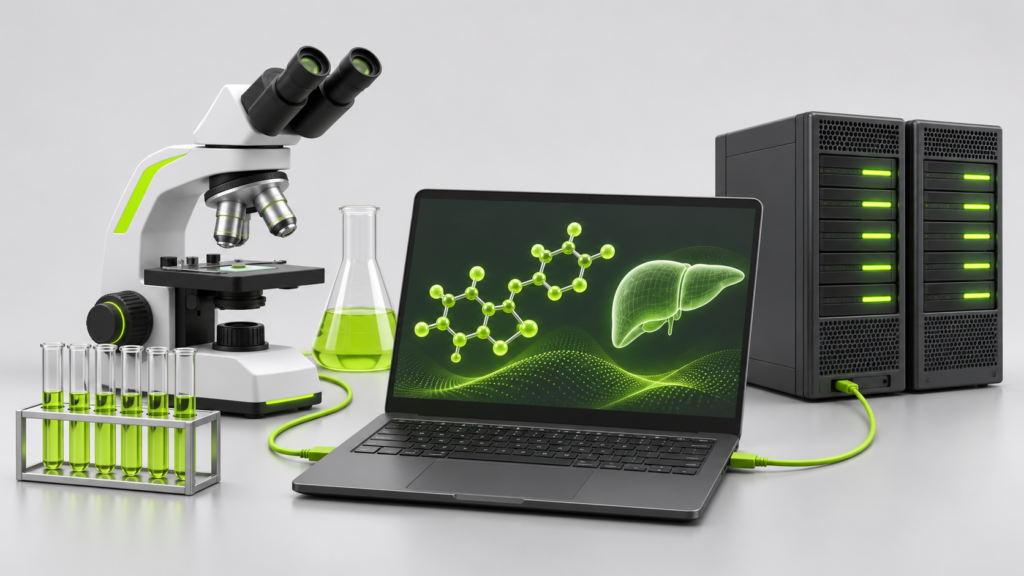
As discussed in episode 3 the AI revolution is accelerating the pace at which everyone must work, and the Life Science & Healthcare sector is no exception. As a partner to many clients in the sector, we already see the commercial challenges. In chemistry, for example, businesses face increasing pressure to adopt AI to remain competitive.
The Greenlight Computers team is rapidly building its AI skills rapidly for both internal use and customer support, but we expect partnerships with larger industry players to grow over the next few years.
AI impact on Life Science & Healthcare sector
Research, clinical trials and patient care are expected to advance dramatically over the next few years, shifting the industry towards shorter development cycles and more proactive personalised care. These AI advances could be hugely significant in bringing forward potential treatments for physical illnesses, such as cancer. However, AI replacing human interaction is also expected to present new challenges for mental health management.
Some of the areas of rapid advancement include:
- Computational discovery, testing thousands of chemical compounds against identified disease targets to narrow down the most promising candidates for laboratory trials.
- Synthetic twinning of organs or cells, using AI to create a biological twin that can undergo drug trials before human trials.
- Patient matching for trials, historically a long, drawn-out process, which could accelerate as healthcare systems become more connected.
- AI-assisted medical note-taking, enabling key clinicians to focus more on patients and creating large, searchable databases for case comparison.
- Predictive diagnosis using social factors or enhanced AI imaging tools to help identify cancers earlier, when they are significantly more treatable.
- Supply chain efficiencies and improvements to help reduce the cost of medicine and cut waste.
But with advancement come new challenges:
- The deeper AI gets into patient diagnosis and recommendations, the harder it becomes for health professionals to validate its outputs and keep pace.
- Data governance and privacy, which are highly regulated across the globe, face challenges around the data AI systems can access and use to inform their outputs.
- The sector has well-defined drug development pathways with established financial and data models. As development accelerates, how will these pathways adapt?
- IP (Intellectual Property) protection is threatened by AI access to, and redistribution of, knowledge. Without protection, will investment be too risky?
These opportunities and risks are closely linked to IT and data security, data management and data capacity planning. An IT partner must understand these areas, enable progress and help mitigate the risks.
Increasing IT Budgets
When we ask a variety of agencies and AI platforms, their responses echo the findings of the following question put to Google Gemini:
Q – what percentage of income will an SME spent on IT in 2027?
A – On average, a Small and Medium Enterprise (SME) will spend 4% to 7% of its annual revenue on IT. However, because company size and industry drive significant variance in technology budgets, actual spend often spans a broader continuum from 3% to 10%.
Smaller companies spend a higher percentage of their revenue on IT than large enterprises due to fixed baseline infrastructure costs (e.g., cyber security, software licensing, core networking) that cannot be scaled down.
| Enterprise Category | Company Size (Employees) | Typical IT Spend (% of Revenue) | Average Annual Per-Employee Cost |
| Micro-SMEs | 1 – 49 employees | 6.0% – 8.5% | $2,000 – $3,500 |
| Mid-Market SMEs | 50 – 249 employees | 4.0% – 6.0% | $1,500 – $2,500 |
| Large Enterprises (for context) | 250+ employees | 2.5% – 4.0% | $1,200 – $2,000 |
Variation by Industry
Industry context heavily shifts the benchmark:
- High-Tech & Financial Services: 7% – 10% of revenue due to regulatory compliance, security overhead, and product development.
- Healthcare & Life Sciences: 6% – 9% of revenue driven by HIPAA/GDPR compliance, data integration, and specialised equipment software.
- Professional & Business Services: 4% – 7% of revenue.
- Retail & E-commerce: 3% – 6% of revenue.
- Manufacturing, Construction & Logistics: 2% – 4% of revenue.
What Drivers Are Expanding 2027 Budgets?
- AI & SaaS Integration: Cloud spending and generative AI tools (such as automated customer support, coding assistants, and operational co-pilots) are shifting IT spend from one-off capital expenditures to recurring SaaS operational costs.
- Cybersecurity & Compliance Requirements: Heightened cyber threats and strict regulatory standards require SMEs to dedicate 15% to 25% of their total IT budget strictly to security and data compliance.
- Managed Services (MSPs): Many SMEs outsource non-core IT functions to Managed Service Providers, which stabilises budget planning around a fixed per-user monthly fee.
Greenlight Computers and IT services of the future
During the 2000s, IT was simple compared with today, typically consisting of an on-premises server, network, firewall and user computers for access. Antivirus software and a firewall were the mainstays of security, with backups taken regularly to local drives or tape. Your IT partner provided a largely reactive “break-fix” service. The IT help desk and ticketing system were at the core of most IT partners’ operations.
In the 2010s, we saw the migration to cloud computing take off, with servers becoming virtual, the emergence of big data storage and Microsoft 365 starting to take over the email and office application environment. We saw IT partners grow into MSPs, taking a more proactive approach to managing and monitoring IT, both on-premises and in the cloud. Most MSPs now have some form of NOC (Network Operations Centre) alongside the help desk.
The 2020s have seen a dramatic shift in requirements for more robust cyber security, a huge increase in cloud applications and SaaS solutions, and now the AI revolution. For IT partners, this has meant a move towards managed security services, while some smaller providers have ceased operating as requirements have become more complex.
For Greenlight Computers, the 2020s have seen the business grow quickly into an MSSP, supported by a large number of strategic partners to meet the needs of our clients in Life Science & Healthcare and other regulated sectors. Our technology partners include:
- Microsoft Modern Workplace
- Lenovo CSP
- Acronis
- ESET
- Cisco & Ubiquiti
- SonicWall
- Kaseya
- TD SYNNEX
- Westcoast
- And many more Application providers
The IT support help desk remains core but now works alongside integrated NOC monitoring and AI-automated reporting tools to identify risks proactively. The Greenlight SOC (Security Operations Centre) is continuously developing as we see security software vendors adapting their tools to compete with AI use by threat actors globally.
In reality, we don’t expect this pace of change to slow down. While the costs of help desk services, cloud server solutions and network infrastructure solutions are stable, the budgets needed for AI tools and cyber security solutions are expected to continue increasing.
The table below shows typical daily attack volumes targeted at an SME and blocked by cyber security tools.
Breakdown of Daily Defended Events
| Threat Level & Type | Daily Volume Defended (Typical SME) | What Is Happening? |
| Automated Scanning & Port Probes | 1,000 – 10,000+ events/day | Botnets constantly scanning the SME’s external IP addresses for exposed ports, known software vulnerabilities, or misconfigured firewalls. |
| Email Threats (Phishing & Spam) | 50 – 500+ emails/day | Secure Email Gateways (SEGs) blocking spam, malicious attachments, weaponized links, and spoofed domain attempts. |
| Credential & Brute-Force Attacks | 100 – 1,000+ login attempts/day | Automated scripts attempting credential stuffing or brute-forcing accounts (e.g., M365, VPNs, or Remote Desktop connections). |
| Endpoint Malware / Bad Web Requests | 5 – 50 blocks/day | Endpoint Detection & Response (EDR) or web filters catching malicious scripts, suspicious downloads, or blocked domain requests on employee devices. |
| Actual “Actionable” Incidents | 1 – 2 per week | Multi-stage, human-influenced, or sophisticated phishing/intrusion attempts that bypass perimeter filters and require human IT/Security intervention. |
The skills required by Greenlight Computers are spread across a large team of technicians, as each security application or device requires specific configuration for the client’s circumstances. For the benefit of all clients, Greenlight Computers’ consultants and account management team will look to standardise tools and configurations where possible, while helping clients train their own staff to remain vigilant.
Computer users are typically unaware that their actions can leave vulnerabilities open to attack. Following the agreed shutdown and restart process is an important part of ensuring software security updates are completed. Simply closing a laptop lid may leave required updates or restarts outstanding. In 2026, we now have reports from ESET showing a league table of vulnerabilities per computer, and enforced shutdowns will become mandatory in 2027 to help protect both users and clients.
Summary
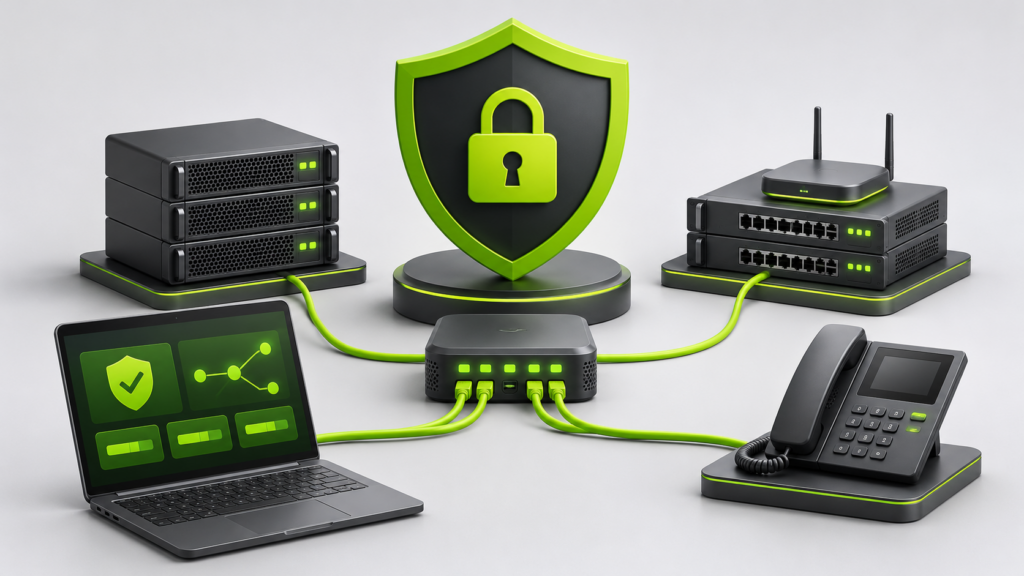
The 2027 – 2030 period will see a significant growth in expenditure on Cyber Security and processing capacity to enable the best use of AI for Greenlight clients. The new AI-dominated world is going to accelerate the rate of change and challenges facing all IT partners and MSSPs. We feel we have the right people to grow the business through reputation, responsiveness and security minded approach to AI.
Working in partnership with key vendors and client QA functions to govern AI use and realise its potential benefits will make for a dynamic work environment for our growing team.
As we are seeing in regular news stories, the cyber threat and hacking landscape is getting worse. There is a real possibility that some clients will experience a cyber attack in 2027, and it’s essential that clients have effective cyber insurance in place for that eventuality. With the right protection tools and incident mitigation measures, our goal is to minimise the risk to our clients and encourage their teams to take the same responsible approach.
Next episode – 5
In the next episode of this 20-year celebration, we will cover the years beyond 2030 and the continued development of Greenlight Computers as a Life Science & Healthcare specialist MSP. We will explore increasing our UK market share in the sector through science park expansion and delivering locally with global skills and reach.
Onward and upward.